Showing posts with label light leak. Show all posts

25.8.13

why film? part two

lomo lca+, 2013 
In part one of my investigation into my reasons for exclusively using film, I set up the questions surrounding my assumption that, generally speaking, film offers a closer representation of the real than digital technology. And there were a lot of questions, and a lot of contradictions. This surprised even me. It also led to a lot of introspective thought on my part, as I searched all the logic in my head to try to find answers. I've always known why I love film: its honesty. I just had to figure out why I so steadfastly believe that film and honesty are inextricably linked.

Before I go into my conclusions, I want to take a moment to explain why honesty in my photography is so important to me. Photography is, among other things, an art form. As such, creative people have long been pushing the medium - both with film and digital technologies - to produce wonderful, fantastical images that are very obviously not representations of reality. Some artists, such as Jeff Wall, employ meticulous staging and production techniques to challenge our very assumptions of truth in the image. All of these approaches to photography are valid. Many artists create brilliant, important work by presenting visual untruths.

In most of my work, however, I aim to capture actual truths. I mean this both in the journalistic sense, where my social and travel photography documents people and places as they exist at a moment in time, and in a more literal sense, where I aim to keep my (sometimes staged) portraits and press shots free of any post-production manipulation. It is the medium's ability to capture an image of reality, as Bazin discussed, that draws me to the camera again and again. And I think this implication of truth in the image, and particularly in photojournalism, is why we collectively feel so cheated when a journalistic image is exposed as a hoax, or even as a manipulated version of reality (such as the war photos of freelance photojournalist Adnan Hajj, which were revealed to be heavily doctored after being published globally via Reuters).

nikon f4, 2013 
But Greta, you might say, your multiple exposures don't represent truth! The world doesn't look like that! And you would be right in the sense that during the gig depicted in the above photo, for example, there were not two identical guitarists on the stage. However, in all my multiple exposures, each image within the frame is a representation of truth, and usually there is some 'real' connection between the exposures (for example, a person and the environment they're in, or, as above, the same person mere moments apart). Furthermore, the process of exposing such images - all within the camera, on film - is also keenly related to truth and authenticity. But more on that in part three.

Digital is just as capable of being honest with us as film is. There is no reason why a digital camera can't capture as much truth as a film camera can. And, as we have seen, film cameras (and film photos that have been digitally edited after the fact) are just as capable of telling untruths as digital cameras. So - back to the issue at hand - why do I (and others) more readily associate film with truth, and digital with deception? My reasoning can be separated into two distinct arguments: the psychological and the practical.

splitcam, 2013 
psychological factors

Most of us have grown up with scores of family photo albums. Those enormous tomes, with pages where the plastic sheets peel away to unleash faded prints laid over cut newspaper (lest they stick to the board), mapping out pieces of lives once lived. Some prints have rounded corners. Some are torn. Some have that strange textured surface, like a miniature grid. Maybe some are really old - cracked black and white wedding photos of great aunties, or baby portraits of Grandpa. There may be sepia, and dust marks or scratches. There may even be a few photos with strange multiple images because someone forgot to wind on the film. There will be dated fashions: long hair and crocheted bikinis of the seventies; smart hats and daytime gloves of the fifties; mullets and fluoro colours of the eighties. There are picnics, birthday parties (complete with Women's Weekly party cakes), camping trips, Christmas trees, grinning kids with missing teeth, dress-up days, first days of school, weddings, debutante balls, pregnant bellies, bassinets. All of these common events appear to create a distinct tapestry of life. Each family has a different history; each album is filled with an enormous array of stories unique to those lives.

But for all the myriad variations that exist from family to family and album to album, each of these exorbitantly heavy, dust-covered epics have something in common: when we look at the images within, we know that they are real. Mum did bake that swimming pool cake. Your sister did wear those fluoro leggings. Your grandpa was wearing a dress for his 1920s baby portrait. There was no Photoshopping when your parents got married in 1976. No-one airbrushed the pimples on your cousin's chin when he won that under-18s footy trophy in 1989. These photos show us life through the poor-quality lenses of our family's past.

diana, c. 2009 

holga, 2012 

holga, 2012 
It is for this reason that when we see the faded colours, the vignetting, the soft focus and/or the multiple exposures that are now synonymous with Lomography cameras and other analogue toy/plastic cameras, we feel that we can trust them more than, say, a glaringly flawless digital image. Whether it's conscious or not - and I suspect in most cases, it isn't - our attraction to analogue aesthetics is a rejection of the superficiality inherent in so much digital technology. We collectively crave a return to the real. I have no doubt that this accounts for the unprecedented popularity of Instagram - the retro aesthetic that the app employs combines with its primary function of taking 'instant' photos to present a modern-day version of the Polaroid; a real moment in time, captured in a few seconds and instantaneously broadcasted to the world, with no time for trickery (apart from the regimented filters, which in turn contribute to the psychological acceptance of truth in the image... get it?!).

nikon f4, 2013   

nikon f4, 2013 

nikon f4, cross-processed slide, 2011 

nikon f4, cross-processed slide, 2011 
To a lesser extent, the subtle analogue characteristics that are often present in 'professional' film cameras (such as high-end SLRs) function in the same way: the grain of a high-speed film, the complex saturation of a cross-processed slide film, the tiny specks of dust that attach to the negative during scanning, a carefully considered in-camera multiple exposure. Many of these things are sometimes considered to be imperfections, but to me, they are precisely the opposite; they are perfect because they denote the truth.

Coming up in part three: practical factors.

4.3.13

a few types o' portraits

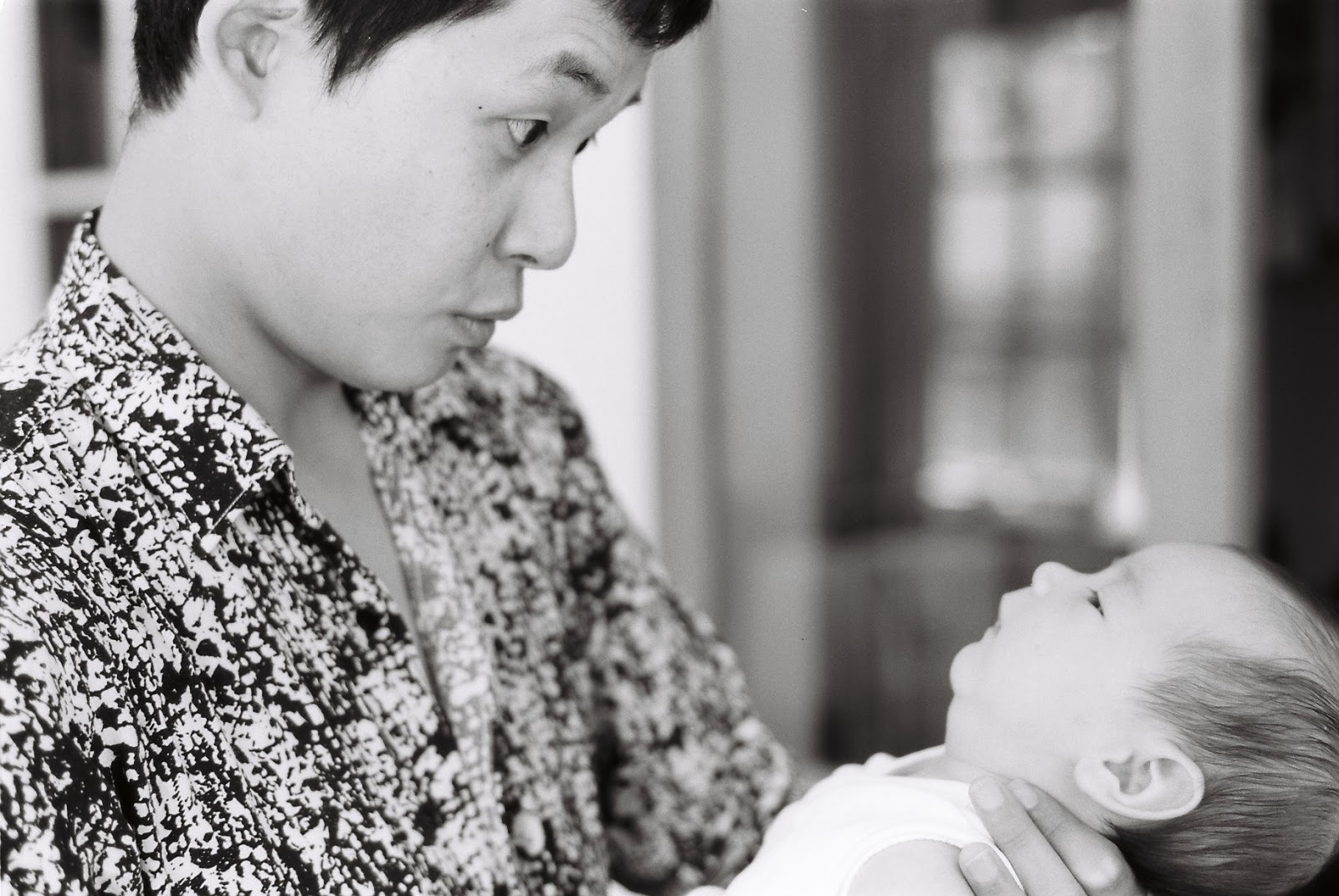
One of my friends recently had a baby. This is relatively new for me; despite being 'of age', very few of my close friends have come to procreate. (Yet.) So when I told this friend that I would love to come and meet his baby, he invited me over and asked me to bring my camera. YES!

I've never shot newborns before, but I figured that there can't be much to it - they look so damned cute regardless of what the camera does. And I was right! What a beautiful picture of a beautiful baby.


Here's a couple with Dad a little more involved. They're so lovely, and one of the nicest things is, they really don't need a lot of forethought or analysis; they are gorgeous simply because of what is in them.


Now, I'm not saying Jim isn't naturally gorgeous... but these photos took a lot of forethought! Which is because, unlike some casual snapshots of a friend, these are carefully planned press shots for the one and only Grizzly Jim Lawrie. I'd never purposely gone after sun glare (aka lens flare) before, and I wasn't sure how easy it would be to achieve. But we both agreed that regardless of actual glare, we wanted to capitalise on the early evening golden sunshine - my favourite kind of light. As it turned out, the flare worked pretty beautifully too!

The first two of Jim are being used as press photos. I liked this one, but he thought it looked like he was holding some kind of intergalactic weapon. Fair enough.

So in the first instance, it was a friend's baby, where I could shoot however I wanted - very natural, very spontaneous and organic. Then there was the music press shot, where creativity is still prized, but you work within certain boundaries to achieve a previously agreed-upon goal. Now we have what is perhaps the least flexible type of portrait I've ever done: the actor's headshot.

I did quite a lot of research to figure out what kind of guidelines, or rules, existed when it came to professional headshots. My understanding is that agents and casting directors (is that what they're called?) generally don't want anything too 'different' - which for me means no grain, no wacky angles, no warped colours, no candid moments. It was an interesting challenge, and I think this image was a good result. I shot Rachel from above because everyone looks better like that (there's a reason all the stupid girls take their selfies with arms stretched up to the bloody ceiling), and I used a film with natural tones and fine grain. Look who knows if this is a desirable outcome in terms of the industry - but you can see her face, she looks pretty, it doesn't look airbrushed, and it doesn't look like she's advertising toilet spray. Also, Rachel likes it. So as far as I'm concerned, it's a winner.

Is there a conclusion to this somewhat strange mixture of portraits? Well, I guess it's that portraits vary a lot! But perhaps also this: even the most straightforward, rigid type of portrait can engage if you connect with your subject and capture something of who they are. (OK I guess that's not technically a conclusion, in that I haven't specifically discussed it in the body of the post, but I still think it's true so it will remain my final thought.)

15.12.12

meredith haze

For those who have been, and even some of those who haven't, the Meredith Music Festival (and its sister, Golden Plains) is instantly recognisable in photos due to several of the Amphitheatre's iconic features that pop up in happy snaps all over the place twice each year. The hill, the Pink Flamingo bar, the dead painted tree (which I'm sure has been given some kind of name other than that sad and sorry description), the ferris wheel, the stage. Even the crowd - a mixed bag of young trendsters and old rockers and everything in between, sometimes thrusting their shoes skyward - is somehow almost distinguishable from many other festivals.

These things pop up in my photos, too, and I think that their presence makes any other descriptive properties unnecessary. This means I can take marvellously unclear photos like these, and they still very strongly convey a specific time and place.

I'm not going to write any more because, well, if I'm honest with you, I'm very tired and anything I write now will be a bit sub-par. But I want to share the photos. So here they are.


3.12.12

ten unconventional wedding portraits

When Craig and Sarah asked me to travel to Adelaide to be their 'official' wedding photographer, I kind of freaked out. I've taken photos at a wedding before, but never in any kind of official capacity. So many questions flew through my head: What if they don't like the results? What if my cameras break? What if I get the settings wrong? What if I catch the flu the week of the wedding? What if I panic and can't do the job?

Earlier this year I met with Craig and Sarah to talk about it. I expressed my reluctance but they assured me that they knew my style, loved my style, weren't after anything too conventional, were open to experimentation, and were happy to collaborate on ideas while also leaving creative control to me. I said I wasn't comfortable taking photos during the ceremony; they told me they would ask someone else to shoot that part. I told them I didn't like the idea of taking large family portraits, or photos of all the groomsmen holding up the bride (and other tacky cliches); they said they were absolutely happy not to have those photos. So I agreed, and my first paid wedding job was essentially underway.

They are both extremely creative people - Sarah is a marvellous illustrator and Craig an excellent musician - and it was this creative understanding, for lack of a better description, that sealed the deal for me. Being able to really experiment while shooting the wedding, and to have them not only accommodate it but wholeheartedly embrace it, was kind of a dream come true.

Having said all that, I have to confess that these first two shots were accidental! I was using a new camera for the first time and had the settings all wrong without realising. I thought they wouldn't work out at all and just wrote those ones off, but when I got them back I was thrilled and pretty amazed at the results. The complete lack of any detail gives them a gorgeous, dreamy feel. The top one especially is totally haunting. Without context, I wonder if you would even recognise it as a bride and groom? Probably just, with that full white skirt - but only just. I adore these shots and am so pleased to now know how to achieve them (intentionally).

It wasn't just accidental experimentation that took place; the rest of the images were absolutely intended to be as far as possible from your standard wedding photo.

Well this I am just in love with. The double exposure is classic Greta, if I do say so, but there is so much more to the image: the sun glare bathing the whole thing in muted gold while also concentrated on the couple, as though the light shines just for and on them; the clouds and the beach being visible but not outstanding; the very natural body language between the two - a lovely moment of everyday communication on a very extraordinary day.

And speaking of classic Greta... you know if you've ever read this blog before that I have a photographic foot fetish, so I insisted that they take off their shoes and let me see the feet in all their glory. And why shouldn't they be the star of the show? Don't they look wonderful? Sometimes I really do think that feet say just as much as, if not more than, any face.

Another dreamy, nondescript image. Wedding in the sky. With many of these beach photos I really had to try to work around the very harsh sun: it hadn't set enough to be soft and golden, so I ended up shooting a lot of silhouetted images. In a lot of cases, like this one, it was a good move.

I HAVE WANTED TO TAKE A PHOTO JUST LIKE THIS FOR AT LEAST TWO YEARS. It was a vision in my head that planted itself there back when I was experimenting with psychedelic palm trees, but until now I had never executed it. But here it is! Excellent outcome.

I don't love this one as much as some of the others, but it still holds interest because the bride and groom are in it, but only just visible. It's a great concept, but perhaps not as wonderfully executed as it could be. But a good basis for experimentation nonetheless.

I love absolutely everything about this photo. Craig gave a beautiful speech at the reception, and afterwards left it sitting on a bench, open just like that. His final words were his dedication to his new wife - said once to her, and once to everyone else as a prompt to raise glasses and toast her. And that is the essence of everything he said, of everything he felt and of the purpose of the day. Here is Craig's love for Sarah. I adore the selective focus, the muted, deep colours, and the stunning grain. And it is hands down one of my favourite portraits of the day. Moving even further from the feet concept, this demonstrates to me how a stunning, powerful portrait doesn't need to include any people at all.

This is another of my favourites. I'm actually quite in love with it, and it never fails to make me feel and react when I see it. Some context: Craig had just removed the garter from Sarah's leg using his teeth, and it was hanging from his mouth. Again, a stunning unconventional portrait of new husband and wife. The composition, the soft focus, the colours, the grain: it all just works.

Perhaps this is the most conventional of all of these, but it's still quite unusual in the sense that it's not posed, you can't see their faces, and it's so dark that you're not sure of exactly what's going on. In fact, they were walking out of the reception and about to leave to spend their first night together as husband and wife. So it's really the last anybody saw of them - the image we were left with. In that sense, it's lovely. And the dark background adds an unusual element of mystery. Definitely not a word used to describe most wedding photos.

Of course, I did actually take some photos where they were both fully visible. Plus a lot more than that. But in the interest of diversity, here are the experimental shots. The ones that Sarah and Craig encouraged me to take, and the ones that we all love to bits - in some cases even more than the conventional shots (you know, like the ones with their faces). I am just so grateful that it was a required part of what they wanted. It really makes me feel pretty strongly that when it comes to my photography for others, the best results come with open minds and willing collaboration.
20.3.12

another trip to the amphitheatre


Golden Plains was pretty special this year. I mean, most Aunty Meredith devotees would say that every event is out-of-this-world amazing, regardless of weather, line-up or company. But this Golden Plains Sixxx hit it out of the park on all fronts: wonderful company made up of a group of close friends; weather that demanded bare limbs during the day and jumpers after sundown; and a diverse line-up that included everyone from world-class soul icons (Charles Bradley) to bright young things (First Aid Kit) and even my dear friends and photographic subjects Saskwatch (who, in a moment of great albeit unwarranted pride for me, had the entire amphitheatre ecstatically involved).

Somewhat surprisingly, I didn't take many photos. I think it was a case of wanting to enjoy the festival, make the most of the ambiance and avoid missing anything because of a camera over my face. This is probably not great photographic practice, but it made for a wonderful festival.

But I did take some photos. And while they're not brilliant, and they're certainly not plentiful, they are unmistakably of the moment, and enough to ensure some memories of the long weekend will stick around for a while yet.

21.2.12

plastic summer

Whenever I see sun-drenched, washed-out images like this, I can't help but think of this song. Like the tune, such photos automatically bring to mind memories of wilting in front of fans, feeling the heat rise from the footpaths, aching for the ocean, tasting sweat on your upper lip. Sure, a lot of these things are unpleasant, but their very existence implies greater things that only summer can deliver: quenching that desire for the sea in one glorious dive, walking barefoot through the balmy air of a hot night without the need for a cardigan, embracing the sweat and giving in completely to the all-encompassing feeling of heat. It's a pretty marvellous thing.

The weather is brilliant in its capacity to pardon behaviour that would otherwise be deemed somewhat inappropriate. Like lying on the couch with your housemates all day, taking turns to spray each other with water from a $2.99 Kmart spray bottle, because your beautiful old house is badly insulated and you don't have air con and there's not a damn thing else you can do.

Driving in the summer. Everyone remembers what it was like to take family trips in a car where the air con consisted of four windows wound as far down as they could go and the wind matted your hair and threatened to blow all your eyelashes off while it was at it. Hell, if you're anything like me it's not even a distant memory; who doesn't have a friend who drives a bomb? I reckon Craig here is in a car that would definitely have air con, but perhaps with an eight-hour, hungover drive to Adelaide ahead of him, cool air isn't that great a consolation.

Well it wouldn't be summer in Australia without alcoholic refreshments, and it wouldn't be summer in Melbourne without a bloody beer garden or two. The smoking laws mean that beer gardens are utilised year-round as those craving nicotine are happy to brave the crisp air, even in the depths of winter, in order to indulge the addiction. The upside of this is now we have even more choice when it comes to outdoor drinking in the warmer months. Providing blessed shade while the sun is fiercely high in the sky, the umbrellas soon become redundant as that gloriously gentle setting sun creeps under their domain and bathes the drinkers with an early evening embrace. Warm, golden sun, ice cold cider, the promise of a joyously warm night ahead: is there anything better?

Summer in Melbourne can be pretty ruthless at times, but I say roll with it, take the lows with the highs and give thanks for the kind of conditions that we can only dream of during those brutally icy mid-year months.

24.1.12

some thoughts on the beach


Ah, the beach. That wonderful space unlike any other imaginable, which we in Australia are lucky enough to have at virtually every turn. It's a place that is governed by nature alone: witness her mockery when she buries man-made infrastructure over just a few years of changing tides; her majesty when she conjures up thunderous waves that only the most foolish surfers dare to face; or her wrath when she claims a small boat in a rip despite the best efforts of lifesavers, as was happening in the photo at the top of this post. Sometimes she is calm enough to bring serenity to the most tumultuous soul, other times she has enough powerful anger to frighten the most salt-encrusted seaside dweller. No matter the mood she presents, though, she is always raw beauty.

Could this explain the infinite allure of the beach for me and my cameras? Certainly, it plays a part. But there are other factors. As with so many other beloved photographic subjects, there is nostalgia. A childhood by the coast means that I have an essentially neverending store of memories on the sand and in the water. It's also part of the broader national memory, as we Aussies like to take pride in our beautiful beaches, which we have been doing for decades. For what is an Australian summer without the beach? One trip to Bondi is enough to confirm that tourists from all over the globe are fascinated by our iconic shores.

Beyond these somewhat obvious factors, however, there are also social and anthropological aspects of the beach that have long fascinated me. Socially, the beach is the great leveller. Rich, poor, young, old, white, black, thin, fat, devout, athiest - in theory, the beach unites people like very few other spaces can. All those things that govern our behaviour and define us in the real world - from race and class to religion and physical beauty - matter little once we are on the sand. It's as if by stripping off our clothes, we remove our superficial identities. As the immeasurably wise Rennie Ellis wrote of Australian beachgoers in his 1980s photography book Life's a Beach, 'Here, on neutral ground and stripped of their uniforms of pretension, they enjoy easy camaraderie that social convention may not have encouraged elsewhere.' We are all hot, and so we are at the beach. It's often as simple as that.

The beach is also a fascinating space in terms of the behaviour it fosters. The mere fact that walking around half- (or sometimes fully) naked is acceptable on the beach is an indication that there are a different set of rules down there. Inhibitions disappear, sexual energy is rife and people epitomise the carelessness of summer. This is reflected in countless movies: summer flings that take place at the beach struggle to transition into the real, class-defined world (Grease, Cocktail); teens go through rites of passage on their journey to adulthood, learning valuable life lessons before moving on to the next phase of their lives (Where the Boys Are, The Bikini Shop); and irresponsible youths are punished for their reckless abandon through death (Jaws) and law enforcement (Blackrock). The idea of the beach as an environment that cultivates extraordinary behaviour has been linked to the fact that the physical space of the sand - as it lies between land and sea, incorporating both but belonging to neither - is a liminal space whose separateness means that it rejects everyday society's customs. A rebel; volatile like its moods.

So these are a few of the reasons I am completely fascinated by the Australian beach. It's a special place that deserves awe, fear and respect. It deserves to be looked after. And, despite the massive volume of sometimes boring images that result, it truly deserves to be photographed.

3.1.12

aussie christmas


I like to think that there's nowhere else in the world that celebrates Christmas like we do in Australia. (By 'we', I mean my family, and many other Australian families - but not all other Australian families! In such a multicultural society, there are obviously many different global customs being observed throughout the country - not to mention those many Australians who do not celebrate Christmas at all. Just in case you were worried about such a generalisation.) Back to the classic Aussie Christmas - or, should I say, Boxing Day. We've always done a Boxing Day BBQ with extended family. Christmas Day has traditionally been immediate family celebrations, but on the 26th, many members of our large, widespread Irish-Catholic clan get together for a lot of food, booze, kids, cricket and, hopefully, sunshine. The Christmas just gone gave us some spectacular weather, perfect for all of the things I just listed as essential ingredients for a great Boxing Day bonanza.

Being a family event, it is only natural that such traditions bring with them a lot of memories of Christmases past. As such, there is inevitably a certain degree of nostalgia involved. I think that's why I love that these shots are faded, sun-drenched and sprocket-holed - they just remind me so much of the giant old photo albums, with that strange sticky cardboard under the flaps of cellophane, and the falling-out images that discoloured long ago.

This is the first time I've taken sprocket shots without overlapping the images, and I'm happy with the results. In the absence of the multiple exposure trickery, the simplicity of the photos can be more easily associated with old family photos, so it makes the nostalgia more accessible.

Aside from the physical properties of these images, the content also evokes a lot of memories. Stubbies, those stackable plastic chairs, lawn cricket, swingsets, silly children, irresistible children, sunshine. Christmas. Family.